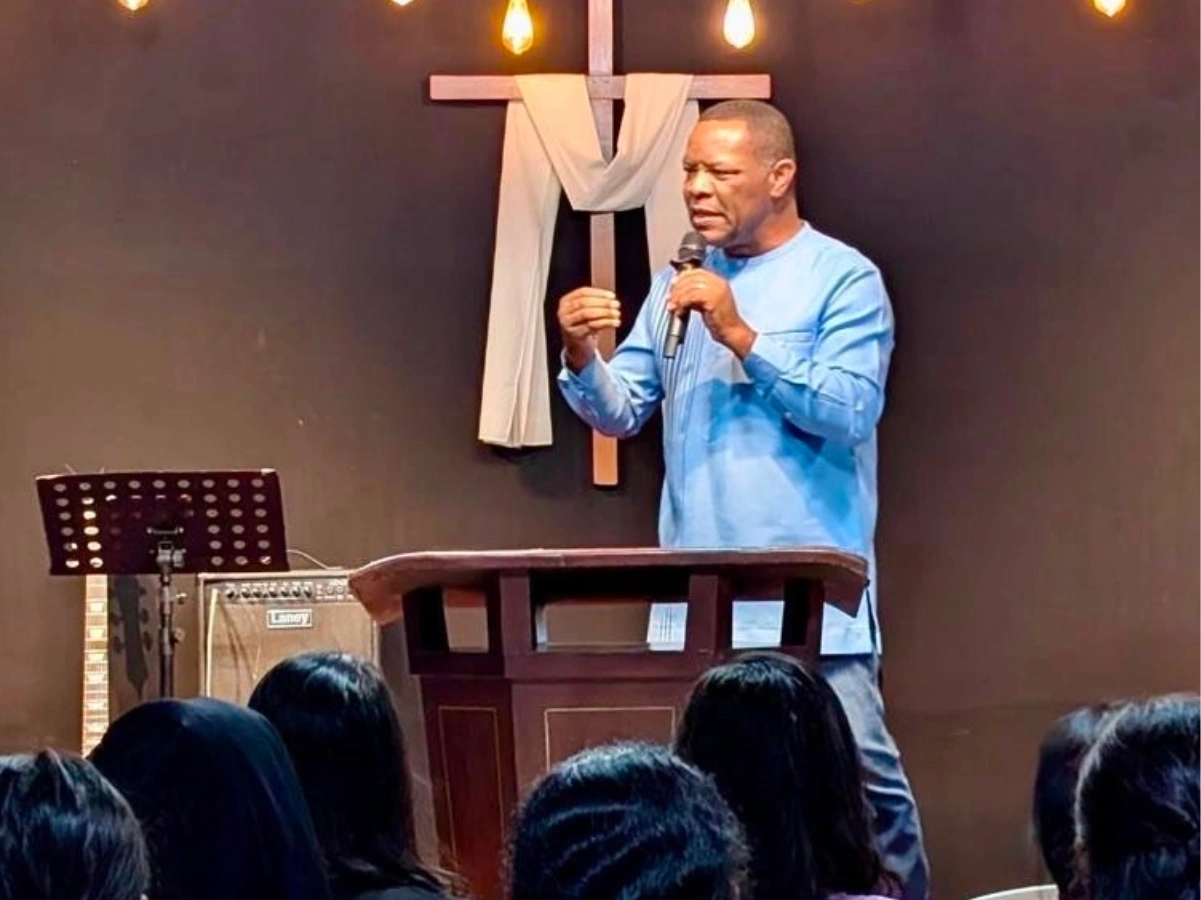
Listen now:




Show Notes
Fred's story begins in a Catholic boys' school in Ghana, where a secretly organized Scripture Union group — disguised as a 5 a.m. jogging club — met in the bushes to memorize Scripture and pray. That underground discipleship set him on a path through music ministry, church planting, and missions across West Africa and beyond.
Fred and Don discuss the shifts reshaping the global church: one in five people alive today is African, and in twenty-five years one in four will be. The church in Africa is growing right along with it, yet Fred asks the sobering question: will the Lord find us faithful?
The heart of the conversation turns to collaboration. Fred challenges Western agencies and churches to trade power and control for humility and shared space, drawing on the "dance of the Trinity," John 17, and the biblical visions of kenosis and koinonia.
Stay to the end, when Fred offers advice to his twenty-year-old self: walk in community, and above all, trust God. If there were ten things to say, he says, all ten of them would be: “Trust God” — because He is faithful.
Links:
The Music Group that Fred toured with: Joyful Way Inc
The Church of Pentecost's Missions Department: The Church of Pentecost - Missions Enterprise
Transcription
Uncle Fred [00:00:00]:
1 out of every 5 people living on Earth today is an African.
Don [00:00:06]:
It's amazing.
Fred [00:00:08]:
And, and, and in 25 years' time, every 1 of 4 people on planet Earth will be African, you know. So the world cannot shut its doors to Africans for long.
Don [00:00:23]:
It's impossible.
Fred [00:00:25]:
Because that will have some serious even economic consequences for any nation.
Don [00:00:31]:
So it was an active Scripture Union group there?
Fred [00:00:34]:
Yeah, active Scripture Union. So I think the influence of those boys in a Catholic school that you were not supposed to be doing things like that, they were operating underground, you know.
Don [00:00:47]:
An underground Protestant movement.
Fred [00:00:51]:
Yeah, I think I'm letting some secrets out today. They actually formed an athletic club, and at 5 AM you heard the whistles blowing and you have to jog to a particular spot on campus. And then we did the— we had to jog from, you know, the hill to the valley, you know.
Don [00:01:17]:
Okay, do a little run and back.
Fred [00:01:20]:
Yes. When we got to the valley, we sneaked into the nearby bushes, and then our mentors, our disciples, you know, will open the Scriptures and challenge us to memorize the Scriptures and lead us in prayers, challenge us to share the gospel, all of those things.
Don [00:01:45]:
This was at dawn? This is like first thing in the morning?
Fred [00:01:49]:
first thing in the morning, and it was all done very quickly. And then, you know, we'll come back to the main road and we'll be singing and get back to the hill. And you can see where—
Don [00:02:05]:
This was when you were like 14 or 15 at this time?
Fred [00:02:08]:
Exactly. Exactly. You know, and so all of those kind of Helped in leading me into a journey that continues up to today. I was in one particular church. I preached 2 services there, and I was shown a family, an elderly man who, not too long ago, he had bought some chemicals, like a poison, And he wanted to have the life of himself and his entire family, you know, just to be killed by, taken out by this poison after an evening meal because they were drowning in debt. And they thought the way out was, you know, We will just go.
Don [00:03:07]:
Suicide.
Fred [00:03:08]:
Yeah. And this church where I ministered in, they had had some kind of an outreach where they have invited people to come for fellowship for free meals, you know, and all of that. And this man came for that fellowship, you know, to partake in the meal. And that's when somebody— he began to experience the love of the brethren and heard the Gospel. And to the glory of God, they didn't take that poison. If there are 10 things that I will talk about, I think number 1 will be trusting God. Number 2 will be trusting God. Number 3 will be trusting God. Trusting God. Number 9 will be trusting God, and number 10 will be trusting God. He's faithful. He's faithful and trustworthy.
Don [00:04:10]:
Welcome to another episode of the Reflexio Podcast. I'm your host, Don Little. In today's episode, I have a long conversation with Uncle Fred, Fred Dimado, from Ghana in West Africa. He talks a little bit about his early days, how he came to a living faith in Christ while at a Catholic high school due to a very active Scripture Union group, then how he got involved with a ministry that traveled, a music team that traveled and did evangelism all over Ghana and eventually other countries in West Africa and then actually as far as Europe and America. Then God led him into indigenous mission, started in Ghana, that was reaching out to unreached peoples in Ghana and elsewhere in Africa. And then God opened up a door and led him into further international leadership with an international mission agency that led him from leaving Ghana and going to Thailand, where he's been for almost 12 years now in Thailand. We have quite a long conversation about the global church. He reflects and describes what God is doing in Africa. Some of what he's seen in Asia since he's moved to Asia. But we also have conversation about the challenges of international collaboration and some of the challenges that we face in that. He calls upon Scripture as a key guide to helping us do a better job of collaborating east-west, north-south, and in the global church and in global mission. So I'm sure you will enjoy this lengthy but deep conversation with Fred.
Don [00:05:55]:
Welcome, Fred, to the Reflexio Podcast. It's a delight to be able to have this conversation with you.
Fred [00:06:01]:
My joy, my joy. Thank you for the invitation. Yes.
Don [00:06:07]:
So people don't necessarily know who you are or know much about you. Can we just start off with telling a little bit about your story? I know you're from Ghana. I don't know, I don't really know your faith journey, but just whatever is relevant and explaining who you are and how God worked in your life. Let's start there. Introduce yourself.
Fred [00:06:31]:
Yeah, thank you again. My name is Fred, from Ghana, and married to Evelyn. We have 4 children.
Don [00:06:44]:
Alright.
Fred [00:06:45]:
3 young ladies and a young man who actually just came home from college for his summer holidays, but currently is around the Myanmar-Thailand border serving refugee communities over there. Yeah. I was born in a Catholic family. I'm grateful to my parents for being very instrumental in my formative years, pointing me to God. At some point, my mom tells me that I said that if I grew up, I wanted to be a Catholic Okay.
Don [00:07:44]:
And where did it go?
Fred [00:07:45]:
Well, I didn't become a Catholic priest, but I believe that it was just me seeing the life of priests who had left home and family, some of them from Ireland and other places, and been serving in different parts of Africa, some of them 30 years, 35 years. never really gone back home and loving people, sharing the gospel, establishing schools, hospitals, caring for the poor, the ministry of compassion and all of those things. I believe, as I watched them, did have an impact on me. At some point, I think the next stage of my journey was just the influence of Scripture Union boys in the boys' boarding school that I was attending.
Don [00:08:50]:
So it was an active Scripture Union group there?
Fred [00:08:53]:
Yeah, active Scripture Union. So, I think the influence of those boys in a Catholic school that you were not supposed to be doing things like that, they were operating underground, you know.
Don [00:09:08]:
Underground Protestant movement.
Fred [00:09:10]:
Yeah, I think I'm letting some secrets out today. They actually formed an athletic club, and at 5:00 AM you heard the whistles blowing and you have to jog to a particular spot on campus. And then we had to jog from you know, the hill to the valley.
Don [00:09:35]:
Okay, do a little run and back.
Fred [00:09:39]:
Yes, when we got to the valley, we sneaked into the nearby bushes. And then our mentors, these are our disciplers, you know, will open the Scriptures and challenge us to memorize the Scriptures and lead us in prayers, challenge us to share the gospel All of those things.
Don [00:10:04]:
This was at dawn? This is like first thing in the morning?
Fred [00:10:07]:
First thing in the morning. And it was all done very quickly. And then, you know, we'll come back to the main road and we'll be singing and get back to the hill. And you can see where—
Don [00:10:24]:
This was when you were like 14 or 15 at this time?
Fred [00:10:27]:
Exactly. Exactly. And so, all of those kind of helped in leading me into a journey that continues up to today. I'll say that in the early '80s, I joined an evangelistic ministry group, a contemporary gospel music group. They sang the Scriptures in in whatever musical form that was invoked.
Don [00:10:58]:
And you were one of the composers?
Fred [00:11:00]:
Well, I was— I didn't— up to now, I haven't composed any song. But I was— I served in this group. We toured different parts of the country. We did— we had a research wing. that will explore areas where there was no gospel presence. And we will look for established churches that were close by some of these areas and people groups that we had identified, and we will have a whole weekend of gospel outreach in partnership with the churches. Yes, exactly. I would say that I had people who mentored me. I had people who held my hands, how to share the gospel from house to house. Later on, I became an administrator of this group. Anyway, to cut a long story short, the next stage was the fact that one of my key mentors, who later on established, you know, an indigenous African mission agency, was also one of the founders of this music group, you know. So God used him for the next phase of my life and that of my wife from this music group, because my wife was also a member of the group at some point.
Don [00:12:39]:
Oh, wow. Okay.
Fred [00:12:42]:
Anyway, so we served in Ghana and moved to Thailand in 2014. We served in Ghana and were involved in church planting and disciple-making efforts, washing the feet of existing and New Gospel Workers. We attended to leadership development, resourcing, and partnership development for this growing and indigenous African mission agency.
Don [00:13:23]:
Can I ask you, back up a little bit, a question? You say you grew up Catholic and, you know, you owe a lot to your parents' nurture. When you basically went in a direction that wasn't Catholic Church focused, was there any tension with your family or did they just bless you and say, this is great? Or was there any story there that has, yeah, that's valuable to share?
Fred [00:13:54]:
Oh, I think as I look back, I'm grateful to my parents. It's not like we had some tension that I can easily recall. I think it was more of coming to a place of reckoning about what I felt was my understanding of God's purpose for my life. I knew that I had been— and there were confirmations by so many others over time. about God calling on me to serve in Ghana and serve in Africa and the world. At that time, it was a prophecy I didn't understand very well.
Don [00:14:47]:
Somebody prayed over you and said, this is what God's calling you to?
Fred [00:14:51]:
There were different occasions, different situations. The affirmations of brothers and sisters who were around me, that they could see the hand of God on me towards a certain direction. I must confess, I didn't understand a whole lot of it. But I think for me, even those early days, I just learned that when it comes to God's calling, you just take what God has given you on a given day. and serve as faithfully as you could. And whatever constitutes the next phase will unfold as you stay the ground and kept going in God's power, just faithfully from one day to another. You know, so that I'll say that that was That has been my story. At some point, I thought I could stay in the Calvary Church and still keep up with exercising my evangelistic gifts and other things. But it was clear to me that there was a need to move in other directions. But I had opportunities still, you see, You know, you've been to West Africa. Normally, the Catholic Church or the Anglican Church, you know, sometimes it's very difficult to see the lines, the boundaries, as you would in other parts of the world. You know, you can go to an Anglican Church that looks more Pentecostal, look more evangelical, looks like everything all together. So some of the categories that we have in mind and assumptions, I'm afraid if you went to the ground in some parts of Africa, some of the categories that we have in mind, the boundaries, they are very blurred. They don't hold. But unfortunately, Most people in the world are not aware of this. So sometimes we fight over, you know, some other things which is not a concern for others in some parts of Africa.
Don [00:17:24]:
So as you're aware, I've had this unexpected privilege after serving 30 years in the Arab world.
Don [00:17:33]:
I've been into Kenya and East Africa many times over the last decade, and I've been to West Africa a few times, to Nigeria, Togo, Benin. And I also visited Ghana once, but I really didn't feel like I visited the country. I was mostly visiting the hotel. But what I've seen in Africa, you know, we all heard about it, but just the tremendous growth of the church, the dynamism. I mean, just last September I was at a church in Nairobi, a dynamic church that was started by Canadian Pentecostals 40 years ago, and that church has become a denomination. It's planting churches all over Africa. That church itself had 4,000 people in it, and they had 4 or 5 other campuses in Nairobi. As we've talked, God is doing some amazing things in Africa. Can you just talk about that and what you're so in awe of God, what he's doing?
Fred [00:18:32]:
Wow. It's an exciting moment, a very sobering moment, particularly when you read some of the records of the past and the forecast that was made for Africa in terms of the spread of the gospel that some other faith, you know, was going to be the dominant faith in Africa. That was the prediction some years back. And so for us—
Don [00:19:16]:
They expected Islam to dominate.
Fred [00:19:18]:
Exactly. Yeah. And so to look back and to see that, wow, I mean, it's like you want to say, oh, see what God has done. And it is, it is marvelous to, to behold. You know, I like to look at things this way. You know, like I was reading about, at the risk of deviating, I was reading about China's current population of 1.4 billion. which is expected to decline to 800 million or even less by the end of this century.
Don [00:20:05]:
This is China. Wow.
Fred [00:20:07]:
Yes. But, you know, the forecast is not the same for, for Africa. Africa's population grew 5 times from 1950 till now.
Don [00:20:21]:
5 times.
Fred [00:20:23]:
5 times. And the current figure of 1.5 million, that is 19 to 20% of the world's population.
Don [00:20:37]:
1.5 billion, right?
Fred [00:20:40]:
Billion. Yes, yes, yes. 1.5 billion, which is 19 to 20% of the world's population is expected to reach 2.5 billion by 2050.
Don [00:20:56]:
That's less than 25 years. Wow.
Fred [00:20:59]:
That is less than 25 years from now and about 3.7 billion by 2100.
Don [00:21:12]:
It'll become perhaps more, almost half the population of the world.
Fred [00:21:16]:
Yeah, you're right. So, and what this means is that 1 out of every 5 people living on Earth today is an African.
Don [00:21:26]:
It's amazing.
Fred [00:21:29]:
And, and, and in 25 years' time, every 1 of 4 people on planet Earth will be African. You know, so the world cannot shut its doors to Africans for long.
Don [00:21:43]:
It's impossible.
Fred [00:21:45]:
Because that will have some serious, even economic consequences for any nation. Yeah. So already the continent is a strategic economic battlefront for China, Europe, and many others, as, as you know. So currently Africa has the most Christians on any continent and it's on the move. And if current signs of growth, signs of hope continue, it will become the largest of the church of the future.
Don [00:22:31]:
Yeah, it almost is already, but it's very soon. Yeah,
Fred [00:22:36]:
of course we need to keep humble. Um, and, uh, I'm reminded of, uh, an African theologian, uh, who, who, who is, who is, who is in heaven now, uh, who, who, who said that Africa has the momentum, has the surge, has the passion, has the energy, the confidence of the gospel. But I guess I ask the question, will the Lord find us faithful?
Don [00:23:19]:
Okay.
Fred [00:23:21]:
I mean, these are questions that we have to, uh, will the Lord find us faithful? Will we keep the flame of the gospel burning for long? Yeah, we don't want it
Don [00:23:35]:
to be a— we don't want it to flash out and burn out. And yeah,
Fred [00:23:40]:
yeah, you know, um, there are stories that we read which can give you some uncomfortable moments, uh, But we want to trust the mighty work of the Holy Spirit. But at least what we are saying, it should cause us to bow in worship, that, wow, from village to village, from town to town, from city to city, from roadside mothers, sisters, aunties who are frying plantain to to plumbers, to carpenters. Everybody is a participant in the mission of God, and I think the Lord is using this to make Himself known, and so we see the church growing. But how will we keep the flame of the gospel burning for long?
Don [00:24:41]:
You have talked about the demographic surge, but people don't necessarily have much idea of the details of what God is doing through the church.
Fred [00:24:50]:
Just one example, I am not that old, as you can see, but there is a denomination in Ghana that I used to attend the same church with their founder.
Don [00:25:07]:
The founding church?
Fred [00:25:09]:
The founding church in Ghana in the early '80s. And today that denomination has thousands and thousands of believers and branches in more than 100 countries across the world and still sending, you know. And so, and if you go to Nigeria, it's another story altogether.
Don [00:25:33]:
Yes, I've been to Nigeria. It's incredible.
Fred [00:25:36]:
You know, I remember being at the Redeemed Church one time. And yeah, I, I— it was a dazzling kind of ex— is it dazzling or dizzying? You know, you felt dizzy.
Don [00:25:53]:
Just, just so much happened.
Fred [00:25:56]:
Just going around the, the pavilion, you know, that we hear that sometimes it's able to sit close to 1 million people. And this is not just the entire church. This is— A blood gathering. This is just part of— in Lagos.
Don [00:26:15]:
Yes.
Fred [00:26:17]:
And so you can list quite a number of this, you know. So that's just one example. And you can go to Kenya, you can go to Malawi, you know, from one country to another. You can see the amazing move and work of the Holy Spirit over there. And, you know, I was saying that in 2014, we moved to Thailand from Ghana. And took on an Associate International Director role in the organization that I serve. And so we have been in Asia now for 12 years, and there are countries here that were reported to have just a handful of believers. Some 50 to 60 years ago, but are now seeing movements of the redeemed in Christ and taking the gospel to their own people. Yeah, it's, it's an amazing time. So there's so much evidence of growth and evidence of hope that movements and churches in Africa, Asia, Latin America, the Pacific Islands, the Middle East, and North Africa, by the power of the Holy Spirit, are growing in influence and shaping the breadth and scope of global missions. And this is God's work. Not anything that any, any man or woman can take, or agency can dare to take credit for. Right. Even though God in his mercy and grace chooses to work through human instruments, broken people like us. I just returned actually from India. And I remember when I was going, there were just 2 prayers on my lips. You know, my prayer was that, Lord, please open my eyes. Help me to see the ways that You are making Yourself known. How are You revealing Yourself to people, to communities, to families in towns, cities. Give me a glimpse.
Don [00:29:23]:
Yeah, yeah.
Fred [00:29:24]:
Give me a glimpse, you know, and I want to hear the stories of encounters with you and conversions, the turning around that is taking place. the stories of transformation, you know. And I would say that, wow, I was so blessed. I was in one particular church, you know, I preached 2 services there, and I was shown a family, an elderly man who not too long ago, he had bought some chemicals, like a poison. And he wanted to have the life of himself and his entire family, you know, just to be killed by, taken out by this poison after an evening meal because they were drowning in debt. And they thought the way out was, you know, Suicide. Yeah. And this church where I ministered in, they had had some kind of an outreach where they have invited people to come for fellowship, for free meals, you know, and all of that. And this man came for that fellowship, you know, to partake in the meal. And that's when somebody— he began to experience the love of the brethren and heard the gospel. And to the glory of God, they didn't take that poison. Okay. And I was in church and I saw this man and his family, and I spoke to— I told myself, wow, What a story of transformation!
Don [00:31:30]:
So, his whole family has come to Christ?
Fred [00:31:34]:
The whole family, the whole family. I mean, people, story upon story of how they came to faith in Christ, you know, the dreams and visions, and it's amazing. And yet, you know, I was in I was in 3 cities, and 2 of the 3 cities, um, uh, 2 of the 3 cities has a total of 38 million in terms of population.
Don [00:32:09]:
Is this in the south of India? Uh, I think you could say the cities.
Fred [00:32:16]:
Yeah, it's, it's a mid to north. Yeah.
Fred [00:32:22]:
And, uh, the 2 cities, the, the total number of people who profess to be Christians are below 2%.
Don [00:32:30]:
Wow. Wow.
Fred [00:32:32]:
So, but anyway, it's a country with a humongous population. So there, there are, there are amazing stories of, of gospel breakthroughs and And yet we also have to keep humble that whether it's here in Asia or Africa or Latin America or Pacific or around the world, North America, what have you. And, you know, and so I think that's where we have to ask ourselves. some questions. That while we have multiple centers of gospel and missionary activity, and hence more opportunities for learning from the different parts of the body of Christ, we seem to have less and less of the attitudes and postures that will ensure mutual learning and collaboration for gospel advance, you know.
Don [00:33:50]:
You say we have less attitudes that will create good collaboration?
Fred [00:33:57]:
Well, less appetites, you know, lack of willingness. Sometimes that's how it appears. For us to have a humble posture of leaning into this growing movement and churches and ministries. And how may we learn how the Holy Spirit is working? In, in this different context? And how may learning how the Holy Spirit is working speak to us in terms of how we may rethink some of our assumptions and some of our systems and structures and, and, and the traditions that by God's grace have helped us? carried us through the years, but the Lord is always up to a new thing. And so, how do we grow in understanding how the Lord Himself is raising workers for the harvest that He is cultivating? And how is planning looking like? How is mobilization looking like? How is resourcing looking like in all these emerging and growing movements and churches and ministries? And let me just say, a growing, growing number of leaders, amazing leaders, across the different parts of the body, you know.
Don [00:35:56]:
When I was in Ethiopia last summer, we met providentially because of one connection of mine. I was able to introduce a number of agency leaders to the leaders of 2 major denominations, each of them having 14 million believers in Ethiopia.
Fred [00:36:20]:
Wow.
Don [00:36:20]:
And they all— there are 3 denominations like that about the same size, and their leaders are saying, God is sending us to India, God is sending us to Central Asia, God is sending us to Southeast Asia, but we have no way to go. Can you help us? You are an international agency. How can we cooperate? And yet the logistics of making that work is challenging, but also it's like, from your seat, how can we actually make it work that we can collaborate in effective ways with different churches and agencies, first world agencies if you like, people from the West or from Australia, those rising out of Africa, those out of India? Do you see some Things that we're doing, generically speaking, that we're doing wrong or we're just not paying attention to what God is doing that we could shift? How can we make this work and stay in line with what God is doing?
Fred [00:37:28]:
I think that the best way actually to respond to this question perhaps would be to lift our eyes to more of a biblical vision.
Don [00:37:41]:
Okay, tell me more.
Fred [00:37:42]:
Well, I mean, I mean, I can speak for 1 hour and I may run the risk of sharing my, just my thoughts and opinions, and that will be very sad. I think the best thing is for all of us, you know, like that our measuring, Our standard is the Holy Scriptures. And so how may we look at the Scriptures together and begin to discern how we are doing? I am told that missionary statesman John Stott, in his last published sermon said that the greatest hindrance to the advance of the gospel worldwide was the failure of God's people to live like God's people.
Don [00:38:51]:
Absolutely. Yeah.
Fred [00:38:55]:
You know, that kind of statement stops you in your tracks. And it's like, no, we need to pause. You know, it's like the reason why somebody hasn't come to faith is because of my behavior, because of my attitude, because I'm not walking what I believe. Yeah. That's what I'm saying. If we first look at the biblical vision, the Holy Scriptures, to be the— to be the resource for our examination and reflection and, and rethinking, and, and hopefully an examination that can lead to repentance, repentance and renewal and revival, and making adjustments that will help us to really live like God's people. And I think living like God's people will be very strategic in terms of how do we move from here to there. You know, the teaching of the, of the whole of Scripture is that we are to demonstrate godly lives. amongst ourselves and before a watching world. Yes. I know that I need to examine my own heart and be before the Lord in repentance. You know, so, uh, the scriptures will be helpful. And also, you know, uh, we can't talk about this conversation without us remembering The Lord's Prayer for the disciples and for believers across all ages in John 17:21. You know, we know that hours before our Lord was betrayed, He prayed that they may all be one. That they may all be one. And we are part of those were prayed for. You know, as the cross drew closer to him to bear, our unity was on his heart. And the unity must be visible. Aha. So that the world may believe that you have sent me. So what that means is that demonstrable, public, and visible unity is a powerful witness. to Jesus as the one sent by God. Yeah. You know, so we have a wonderful moment in history. The growth, the significant shifts, you know, in the areas of demographic, the cultural compositions, you know, and all. The diversity of gifts, that alone blows my mind all the time. The diversity of gifts, you know. Like, I, I was in— I told you I just came back from India, met some brothers and sisters, and I'm like, whoa, you know, why am I even in my role? I can work under these folks, so sharp. Yeah. You know, but they are serving faithfully at the margins.
Yes. And how do, how do we leverage our roles, the responsibilities? I mean, the place of privilege— we may not even call it privilege, but we, we are in our roles purely by the mercy and grace of God. Right. And I like to believe that We are meant to use our roles to invite others, to welcome others to our leadership tables and, you know, meeting spaces and decision-making spaces and service stations and what have you. But I think the huge— the opportunities are huge in terms of we leaning in. We becoming integrated into what is happening because some of these growing movements and churches and ministries, they are using different approaches to doing what we call missions. different approaches to organizing, different approaches to prayer. Prayer, I mean, prayer is such a big deal. They are focusing on disciple-making. We are talking about gospel flourishing in the context of persecution and suffering. How do you even make Jesus known when you can't talk about Him? You know, to see brethren committing to be the face of Jesus in their home, at their workplace, in the schools, in the market, it's a different kind of orientation. Yeah. And what it means to really be a disciple of Christ. What does it mean to share the gospel? What does it mean to convey the testimony of God? What does it mean to walk the Calvary Road, the way of the cross? So there are different conversations that are going on. And personally, I feel that I have so much to learn from how is the Holy Spirit working in Indonesia? How is He working in Cambodia? How is He working in Nepal? How is He working in Pakistan? You know, how is He working in Afghanistan? He is working, actually. You know, are we willing to go to the margins? Amen. Are we willing to humble ourselves and sit unhurriedly with some of these leaders and learn from them? How are they hearing the calling of God? What are their hopes and aspirations? They feel that God is calling them to also play their rightful place their fullest places in God's eternal work. And am I interested in hearing how they are hearing that? How is their understanding, you know? And how are we engaging in dialogue? How may some of that even speak to the changes that I have to make, you know? So in most cases, it looks like, uh, It's hard to tell whether we really have the appetite to learn from how God is working in the nations of the world or not.
Don [00:46:37]:
I think you've thought about this a lot. Have you got any insights or suggestions to help the agencies that seek to be truly international to, if you were, maybe give up the power that we somehow— we don't think of ourselves as powerful people, but we have some connections. Uh, yeah, how does that look going forward so that an international agency becomes truly global in its attitudes and its realities?
Fred [00:47:11]:
Well, um, I like to— again, we need, we need the biblical vision to guide us.
Don [00:47:22]:
Okay, we all agree to that, but specifically, what do you mean?
Fred [00:47:28]:
Well, I mean, you look at the— you, you look at the, the relationship between Father, Son, and the Holy Spirit, uh, uh, the, the Triune God, or, or what's a lot of people refer to as the dance of the Trinity.
Don [00:47:50]:
Amen.
Fred [00:47:52]:
Where Father, Son, and the Holy Spirit are engaged in this space-making, self-emptying, mutually loving, mutually trusting relationship. There's no competition. There's no uniformity, but each identity is preserved. You don't read anything in the Scriptures where there is some conflict or tension between the Holy Spirit and Jesus. It's all together. Well, you see, wonderful harmony and cohesion. Yes. And that's why I like to say that unless we have reference to something better, we will not even know how we are doing. You know, we will not know how we are doing, you know. And so I think the biblical vision of the dance the dance of the Father, Son, and the Holy Spirit, which results in the provision of space. Space is a big deal. Space. Elaborate. Space, opportunity.
Don [00:49:24]:
Yeah.
Fred [00:49:24]:
You know, recognition, affirmation, Invitation, welcome, you know, welcoming people. It's very important. So you see that the dance of the Holy Spirit results in the provision of space. Each person for the other is the example that we need. You know, There is difference, but there's no division. And like I said, each identity is preserved. And the dance of the Trinity leads to kenosis, which is the space-making that I'm talking about.
Don [00:50:14]:
Kenosis, that's a Greek word. What do you mean by it?
Fred [00:50:18]:
Kenosis, I think, is inspired from Philippians 2:6. Right. You know, and which says, like Jesus, who being in very nature God, did not consider equality with God something to be used to his own advantage. There are so many things that I used for my advantage. I don't know about you, my senior brother, done. So we have the example of Jesus himself. That's why I'm saying that we need a better vision. We need a godly vision to reveal the conditions of our hearts and speak to our attitudes and behaviors and mindsets. you know, speak to issues of pride and control, you know, the use of money and, you know, to, to control decisions and things like that. Unless we, we pause to, you know, to reflect on the scriptures and how we are walking it. That's why I tend to really believe with John Stott, with that statement that he made.
Just last week, I was reading a reflection by a Thai theologian and a farmer. I was telling a friend that, oh, we need to be desperate or very eager to get reflections or writings from some of these growing movements, leaders, churches, and it will help us a lot. And so I'm so glad a brother from another org sent me this writing from a Thai theologian and a farmer. He wrote something titled The Heart of Leadership. And there was just a piece, a portion of his reflective paper that I wrote down. He says, when power is not examined within the heart of the one who holds it, it can gradually shift from service to control. from care to domination and from valuing life to, you know, to something else. I mean, like, this is a Thai theologian. And so the issue about power, control, money, all these things. How does reflections on the relationship between the Father, Son, and the Holy Spirit speak to the values that should guide or speak to our relationships, which then can foster the collaborative mission thinking and practice that is needed for us to really work together. So I think this vision of the dance of the Trinity is, again, is to flow down into our relationships.
So we can't talk about collaboration, we can't talk about partnerships without first pausing to reflect on the biblical values. Otherwise, it's not going to work, you know. And so, may they also be in us so that the world may believe that you have sent me. It is something that should inspire. And I think I talk about kenosis. It's also good to talk about koinonia, which is the, the New Testament concept of, I mean, of, of a relationship. Koinonia challenges us again to reflect the relationship of the Trinity in our dealings with one another, in our relationships with one another. And you know that koinonia has the multidimensional meaning of fellowship, of sharing and contribution. So how do we share the mission space? How do we receive the contributions of others? And the contributions are not necessarily money. Insights. A lot of these emerging movements, they want to play a key role in shaping of Christianity, I mean, in the decades to come. So, not just contribution, but participation and also partnership, you know. So, the basis of our fellowship is what we hold together, what we share together, you know.
It's good to read, um, if you give me a minute, uh, 1 John. 1 John 1. "If we claim to have fellowship with him and yet walk in the darkness, we lie and do not live out the truth. But if we walk in the light as he is in the light, we have fellowship with one another, and the blood of Jesus his Son purifies us from all sin."
Yes, the Holy Spirit is not mentioned in this passage, but it's mentioned in 1 John 3:24, which says, the one who keeps God's commands lives in him and he in them. And this is how we know that he lives in us: we know it by the Spirit he gave us. So practicing koinonia amongst ourselves and in the eyes of the world will be a powerful witness for gospel partnerships and kingdom advance for God's glory, you know. So every conference you attend these days, you, you know, there is a clarion call for collaboration, partnerships, you know, and what have you. Uh, it's a call to link arms You know, with the growing movements, churches and ministries, you know, around the world. So I think that every leader in any mission agencies, I don't think we have the option or the luxury not to care. If you say you don't care, what you are actually saying is that you don't care about what God is doing. Yeah. You don't care about wrestling with this question: what time is this? What is God doing? How may we discern this season, this time, and reposition ourselves to be in alignment with what God is doing? I mean, in John 5, you know, we hear about Jesus who looks out to seeing what His Father is doing, and then He enters into His Father's eternal work. Wow! Think about that. Talk about the need for discernment.
At every point in time, wrestling with what is God doing in my family? is God doing in my community? What is God doing in my city? To be able to see him and see the opportunities so that decision-making is aligned to discernment, you know. So I do believe that, uh, this moment, it's a call to relationships that will involve, um, that will involve self-emptying.
Yeah. I, I will be challenged. You will be challenged, you know. Um, relationship that will involve not the exercise of power and control, but letting go of our own spaces, preferences, and agendas, and let God, let God be God. You know, I believe that every mission agency is, is in a dire need of submitting its systems and structures and procedures to the lordship of Christ. And the growing centers of Christianity are thriving and flourishing with models that offers missionary agencies or institutions an opportunity to rethink our approaches to accomplishing the resourcing, the governing, the planning, and organizing of missions for local and global relevance for God's glory.
Don [01:00:26]:
Amen. Amen. Thank you, Fred. Um, as we run to the end of our time here, um, as I told you earlier, I'd like to ask a similar question at the end of most of my interviews, and that is, as you look back at your 20-year-old self, or put it another way, as you think about a 20-year-old, or maybe like your son who's just finishing college and trying to see, okay, what's God got for me? Any word you have for them, for our brothers and sisters who are starting off in their journey with Christ, and maybe they're sensing a call to some kind of kingdom work? Any encouragement for them from your pilgrimage?
Fred [01:01:18]:
Well, I, I think, um, there is nothing more important in life than wrestling with questions as to what is God's purpose for one's life. It's like, why am I here? Why are we here? You know, and one could go in all kinds of directions, but I think it helps to wrestle with that question. What is God's purpose for my life? You know, and I know I must say that I will, I will not pretend and say that, you know, 20 years ago, 30 years ago, 35 years ago, Like, it was easy for me to have, like, 100% certainty of an answer to that question. But I'm grateful that God put me in a community, a community of fellow brothers and sisters. A community of brothers and sisters who were much older than me, who were more than willing to tolerate my questions and my struggles and mistakes even, but were very committed to loving me and walking with me.
I credit, I honor people like Uncle Dr. T.B. Dankwa of blessed memory, Dr. Solomon Aite, so many, even in the global missions world, people like Doug McConnell, Professor Doug McConnell, John Fletcher. I mean, the list goes on, who all saw me at different stages of my life and made me feel like I also had something to offer. They made me feel like I also have something to contribute in God's eternal work around the world. The element of faith, I mean, the importance of faith, the importance of prayer cannot be underestimated. But much more importantly, intentionally growing in community. Yes. And in community that prioritizes more of a growth towards Christlikeness. Uh-huh. The walking the way of the cross. I feel that those, I mean, that those are issues of, of change, of brokenness, of transformation, you know, this refashioning of our hearts. Into the heart of Christ, you know, to be more like Christ, more like Christ, filled with Jesus, walking in step with the Holy Spirit, living under the cross, you know, the way of the cross. I mean, these themes of discipleship, the Scriptures, the centrality of the Scriptures, the place of prayer. I think those are the things really that have helped me to stay the course. And so I would recommend that to people much, much younger than me, that make sure that you are growing in the community of faith. That you have people who can keep you accountable, who can help you to grow. And then also in terms of the journey, like I said at the beginning, it's always difficult to see the next phase and the next phase and the next phase.
Don [01:06:05]:
We don't know.
Fred [01:06:06]:
Never, never clear to me at any point, you know, never. I just say that, That has been my journey. You know, it has always been in a particular phase. And then God sent somebody to speak a word and orchestrate events, which takes you from this place to that place and to that place. And I remember years ago when I was serving, with this indigenous African mission agency. We had a big conference in the capital. And then at that time, my mentor was already thinking about me, like, going back to school, you know. But then we had the guest speaker who came from outside, you know, and he was there. He spoke the whole week. And then at the periphery of the conference, he called me, you know, and he said, my brother Fred, I feel like God is telling me to tell you that you need to go back to school and then come back to serve Ghana, Africa, and the world.
Don [01:07:26]:
Wow. Expand your ministry.
Fred [01:07:31]:
And then he looked at me and said, look at me, I don't have money, uh, to, to get you scholarship, whatever, you know, but I'm telling you, let's join our hands together in faith and see what the Lord will do.
Don [01:07:49]:
Amen.
Fred [01:07:50]:
That's what he told me. I took his word seriously. To cut a long story short, I found myself in a seminary, you know. And now I can look back and say, oh, wow, because by God's grace, we served in Ghana and we will be going to West Africa, different countries, everything about gospel ministry, travel to East Africa. You know, Southern Africa and all of that. And then to Thailand, you know.
Don [01:08:33]:
Southeast Asia.
Fred [01:08:34]:
Southeast Asia. And in fact, even the calling to Asia in 2014 was preceded by a moment where I had a major health issue. And had a major surgery. And I even thought that was the end for me.
Don [01:09:01]:
You thought it was over?
Fred [01:09:03]:
I thought it was over. I thought it was over. And then at the tail end, just when I was just beginning to make progress, that's when The call came in on that I was being invited to take up an Associate International Director role, you know, and to give attention to our internationalization priorities, which meant issues about, you know, systems, structures, procedures, global partners, and that kind of thing. So it's a mystery. There's a mystery, the faith element.
Just when I thought, you know, like, what am I going to do with my life? You know, like, why would God allow me to, you know, to face a major health crisis and all of those things? And even when we were coming to Asia, it was like, I thank God. My wife said, even if God is calling us, if we have to serve in Asia for only 3 months, let's go. Let's obey. Let's go. Even if it's just 3 months, we'll serve. If it is 12 months, we'll serve. And then He will show us what will be next. Amen! And I thank God for my wife, for just her attunement to hearing the Lord, discerning what the Lord was saying to us. And we came purely in obedience. Yes. And to God be the glory. 3 months have long passed.
Don [01:11:09]:
12 years now.
Fred [01:11:10]:
12 years now, and we are still here. And even though we know that there are other phases, you know, we don't know what the next phase will be, but we want to, by His grace and mercy, serve faithfully like what He has placed in our hands today and trust Him for the next phase. So those are some feeble thoughts and lessons that as I reflect on the journey, which continues, that the Lord has helped us. You know, I wouldn't say that it's been A rosy trip. We've had our moments of difficulty, and that always comes to drive us onto our knees. Yeah. If there are 10 things that I will talk about, I think number 1 will be trusting God, number 2 will be trusting God, number 3 will be trusting God, number 9 will be trusting God, and number 10. We will be trusting God. He is faithful. He is faithful and trustworthy, and that's all I can say.
Don [01:12:34]:
Thank you so much. That's a good point to end our conversation on. Thank you, my brother, and may God continue to bless and use you there in Thailand and wherever He leads you next. Thank you so much.
Fred [01:12:51]:
Amen. God bless you too. Thank you for reaching out to me. I'm grateful.
Don [01:12:56]:
Well, thank you for listening in on this conversation with Uncle Fred. It was a lovely time as we talked about both his own life and what God is doing in the global church and how Western and African and Asian churches and movements can work together in collaborative ways. I trust that you are inspired, perhaps rebuked and encouraged as you watch this episode of Reflexio. I can remind you to give a thumbs up, to make comments. The more you do that, the more other people have opportunities to hear and to watch these conversations with people, God's people, from around the world.
Join Our Community
Be part of a growing network of next-generation mission leaders. Get early access to new episodes, exclusive content, and resources to empower your journey.